
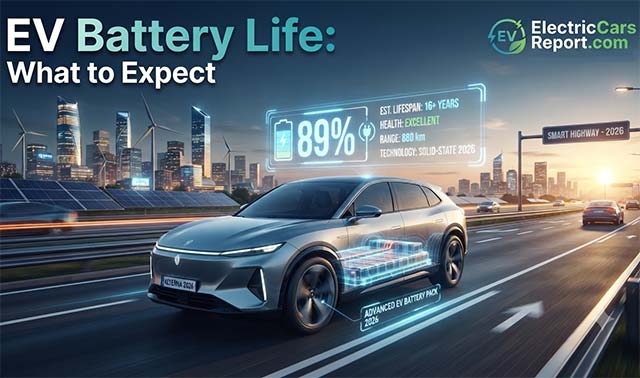
EV battery life is better than most people fear. Real-world data from over 22,700 vehicles shows batteries lose about 2.3% of capacity per year, retaining roughly 81% after 8 years. Heat, fast charging, and sitting at 100% charge speed up wear. Keeping your daily charge between 20% and 80% is the single best habit for long battery life. Most owners never pay for a replacement.
Worried your EV battery will die in a few years and leave you with a $20,000 repair bill? You’re not alone. Battery anxiety is one of the top reasons people hesitate to go electric. But the data tells a much calmer story.
A landmark study of more than 22,700 real-world EVs found that batteries degrade by an average of 2.3% per year. That means after 8 years, the typical EV still holds about 81.6% of its original capacity, well above the 70% threshold most automakers use as their warranty cutoff. In plain terms: your battery will almost certainly outlast your loan payments, and probably your patience with the car’s paint job.
This guide breaks down what actually happens to EV battery life over time, what speeds up wear, and what you can do to protect your investment. We’ll also cover replacement costs so you know exactly what you’re working with, whether you’re shopping for one of the best affordable electric cars or already own one.
How Long Do EV Batteries Actually Last?
Most EV batteries are built to last 15 to 20 years, or well beyond the useful life of the vehicle itself. Multiple large-scale studies back this up. The average battery loses about 2.3% of its capacity per year, meaning a 300-mile EV would still deliver around 238 miles after a decade of normal use.
That number comes from Geotab’s 2025-2026 analysis of more than 22,700 electric vehicles across 21 models, one of the largest real-world battery studies ever conducted. Battery wear affects your driving range, your resale value, and how the car performs day to day, but the overall trend in the data is reassuring: modern EV batteries hold up well beyond the typical years most people keep a car.
Other studies paint an even rosier picture. Recurrent’s 2026 EV Market & Trends Report found that the average EV retains 97% of its range after three years and 95% after five years. A separate UK study of over 8,000 vehicles found an average state of health of 95%, with even 8-to-12-year-old EVs holding up well.
Tesla’s own fleet data tells a similar story at high mileage. According to crowd-sourced tracking, the average Tesla battery holds onto roughly 88-90% of its capacity even after 200,000 miles. If you’re shopping for a longer-range option, our 300-mile range EV buyer’s guide can help you find a model with enough buffer to stay comfortably useful for years to come.
What Causes an EV Battery to Degrade?
Every lithium-ion battery wears down a little each time you use it. That’s just chemistry. But a handful of specific factors determine whether your battery ages gracefully or wears out early.
The biggest culprits are heat, fast charging, and time spent sitting at very high or very low charge levels. Every charge and discharge cycle causes tiny, permanent changes inside the battery cells. Over thousands of cycles, this adds up to reduced capacity. This is called cycle aging.
There’s also calendar aging, which happens simply because time passes, even if you never drive the car. A battery sitting fully charged in a hot garage will age faster than one stored at a moderate charge in a cool space.
Temperature plays a bigger role than most people expect. Extreme heat speeds up the chemical reactions that wear down battery cells, while extreme cold temporarily reduces how much power the battery can deliver. One AAA study found that an EV’s operating range can drop significantly in very cold or very hot weather, mostly because the car has to work harder to heat or cool both the cabin and the battery pack itself.
Does Fast Charging Really Hurt Your Battery?
Yes, frequent fast charging does accelerate battery wear, but only meaningfully if it’s your primary charging method. Geotab’s updated study found that vehicles relying heavily on DC fast charging above 100 kW degraded at about 3.0% per year, roughly double the rate of vehicles that mostly used slower AC charging.
The reason comes down to heat. Fast charging pushes a large amount of energy into the battery in a short window, which generates more internal heat than a slow overnight charge. That heat is the real stressor, not the speed itself.
This doesn’t mean you should avoid fast chargers altogether. They’re one of the best features of owning an EV, especially on road trips. The key is using them as an occasional tool rather than a daily habit. If you can charge at home overnight on a Level 2 charger most of the time, save the fast chargers for longer drives.
LFP or NMC: Does Battery Chemistry Change How Long It Lasts?
Not all EV batteries are built the same way, and the chemistry inside your pack has a real effect on longevity. The two most common types are lithium iron phosphate (LFP) and nickel manganese cobalt (NMC).
LFP batteries generally last longer. Their cycle life often falls between 2,000 and 3,000 full cycles, and some industry estimates push that even higher. The stable internal structure of LFP cells means they hold up better against repeated full charges, which is why many automakers now recommend charging LFP-equipped EVs to 100% regularly without the same longevity concerns that apply to other chemistries.
NMC batteries typically offer a shorter cycle life, often in the 1,000 to 2,000 range, but they pack more energy into a smaller, lighter space. That’s why NMC remains popular in longer-range vehicles where every bit of energy density matters.
Neither chemistry is strictly better. LFP tends to show up in more affordable, shorter-range EVs where durability and cost matter most, while NMC dominates in performance and long-range models. If you’re not sure which type your car or a car you’re considering uses, checking the manufacturer’s spec sheet or owner’s manual will usually tell you.
How Can You Extend Your EV Battery’s Life?
The single most effective habit for battery longevity is keeping your daily charge between 20% and 80%. This range puts far less chemical stress on the cells than routinely charging to 100% or letting the battery run down to empty.
Most EVs let you set a charging limit in the settings menu, so you can plug in every night without worrying about overcharging. Save the full 100% charges for road trips when you actually need the extra range.
A few other habits go a long way too:
– Favor slow charging at home. Level 2 AC charging generates far less heat than DC fast charging, making it easier on the battery over time.
– Protect the battery from extreme temperatures. Park in shade or a garage when you can, and precondition the cabin while the car is still plugged in during cold weather.
– Avoid letting the battery sit empty for long periods. If you’re storing your EV for weeks, aim for a charge level around 40% to 60% rather than full or empty.
– Drive smoothly. Aggressive acceleration and heavy braking generate extra heat and add unnecessary strain.
None of these habits require major sacrifices. Most EV owners naturally fall into good charging patterns just by plugging in overnight and letting the car’s battery management system do the rest.
What Does It Cost to Replace an EV Battery?
Out-of-warranty EV battery replacements typically cost between $5,000 and $22,000, depending on the vehicle and pack size. Smaller packs in compact EVs sit at the lower end, while large or performance-oriented packs run higher.
The good news is that very few owners ever pay this bill. Data from the EV research firm Recurrent shows that only about 2.5% of EVs in its tracked community ever needed a battery replacement. Most vehicles are sold, scrapped, or simply keep running long before the battery drops anywhere near replacement territory.
Warranty coverage also does a lot of heavy lifting here. Nearly all new EVs sold today come with at least an 8-year or 100,000-mile battery warranty, and some manufacturers offer even longer coverage. If your battery’s capacity drops below the manufacturer’s stated threshold, usually around 70%, within that window, the replacement is typically covered at no cost to you.
Battery prices have also been falling steadily as manufacturing scales up, which means future replacements should only get cheaper. If you’re shopping for a used EV, it’s worth reading our guide on what to know before buying a used electric car to learn how to check remaining battery warranty and health before you sign anything.
Conclusion
EV battery life is one of the most misunderstood parts of owning an electric car, and the real data is far more reassuring than the internet rumors suggest. Most batteries lose only a small percentage of their capacity each year, replacements are rare, and manufacturer warranties protect you during the years when problems are most likely to show up.
The habits that matter most are simple: keep your daily charge between 20% and 80%, avoid making fast charging your everyday routine, and try to park out of extreme heat when you can. Do that, and your battery should comfortably outlast your ownership of the car.
Ready to find an EV that fits your driving habits and budget? Browse our latest electric car reviews to compare battery specs, warranties, and real-world range across today’s top models.
Frequently Asked Questions
Do EV batteries need to be replaced like phone batteries?
No. EV batteries are far larger and use more advanced thermal management than phone batteries, so they degrade much more slowly. Most EV batteries are designed to last 15 to 20 years, and the vast majority of owners never need a replacement during normal ownership.
Is it bad to charge my EV to 100% every night?
Regularly charging to 100% and leaving it there can add extra stress to the battery over time, especially with NMC chemistry. It’s better to set a daily charging limit around 80% and reserve full charges for road trips or when you need maximum range.
How does cold weather affect EV battery life?
Cold weather temporarily reduces driving range because the battery works harder and the car uses extra energy to heat the cabin and battery pack. This is a short-term performance dip rather than permanent damage, and range typically returns to normal once temperatures warm up.
What is a normal state-of-health reading for a used EV?
A used EV in the 4-to-8-year range typically shows a state of health between 90% and 95%, based on large fleet studies. Anything close to or above that range is considered healthy, while readings well below 80% may be worth negotiating on price.
Do all EVs use the same type of battery?
No. Most EVs use either lithium iron phosphate (LFP) or nickel manganese cobalt (NMC) batteries. LFP tends to last longer and is common in more affordable models, while NMC offers higher energy density and is more common in longer-range vehicles.
The post EV Battery Life: What to Expect appeared first on Electric Cars Report.